
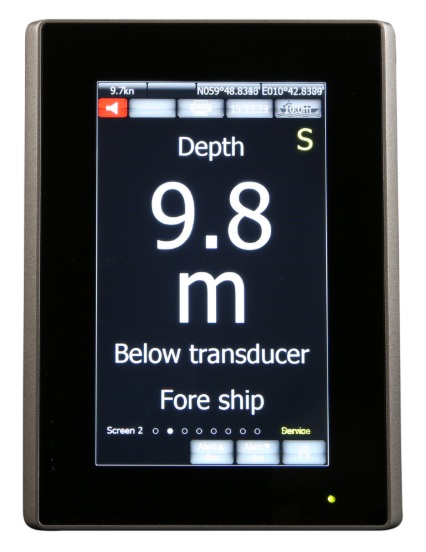
In the vast and often unpredictable world of maritime navigation, understanding what lies beneath your hull is just as important as monitoring the horizon. For shipowners, captains, and marine engineers, the echo sounder is an indispensable piece of technology.
But what exactly is an echo sounder, and why is it a mandatory requirement for modern commercial vessels? In this article, we’ll dive into how these devices work, the different types available, and why they are critical for maritime safety.
Understanding the Echo Sounder: The Eyes of the Subsurface
An echo sounder (often referred to as a “depth sounder” or “fathometer” or ” iskandil ”) is a type of sonar device used to measure the depth of water and identify underwater objects. It transmits acoustic pulses into the water and records the time it takes for the “echo” to bounce back from the seabed or an obstruction.
How Does an Echo Sounder Work?
The operation of a marine echo sounder relies on four primary components:
- Transmitter: Produces the electrical pulse.
- Transducer: Converts the electrical pulse into sound waves and sends them downward. It also “listens” for the returning echo.
- Receiver: Amplifies and processes the returning weak echoes.
- Display Unit: Visualizes the data as a depth reading or a graphical “bottom profile” for the bridge team.
The device calculates depth using a simple formula:
Depth=Speed of Sound ×Time /2
(We divide by 2 because the sound travels to the bottom and back again.)
Key Types of Echo Sounders for Professional Use
Depending on your vessel’s requirements—whether for SOLAS compliance, fishing, or hydrographic surveying—the type of system you need will vary.
1. Single-Beam Echo Sounder
-
Measures depth directly below the vessel
-
Commonly used on commercial ships and fishing vessels
-
Reliable, cost-effective, and easy to maintain
2. Dual-Frequency Echo Sounder
-
Uses both low and high frequencies
-
Improves seabed detection accuracy
-
Ideal for varying bottom conditions such as mud, sand, or rock
3. IMO-Approved Echo Sounders
-
Designed for SOLAS-class vessels
-
Certified according to IMO, IEC, and MED Wheelmark standards
-
Mandatory on most commercial vessels above specified tonnage
Why Every Vessel Needs a Reliable Echo Sounder
1. Preventing Grounding
The most critical role of an echo sounder is safety. By providing real-time data on the “Under Keel Clearance” (UKC), it prevents vessels from running aground in shallow waters, shifting sandbanks, or poorly charted harbors.
2. SOLAS Compliance
For commercial vessels, carrying a Type Approved echo sounder is not just a choice—it’s a legal requirement under IMO SOLAS Chapter V. These systems must provide a graphic record of depth and be able to trigger alarms at preset depth limits.
3. Integration with Navigation Systems
Modern echo sounders, such as those provided by Elektro Deniz, integrate seamlessly via NMEA data with your ECDIS, Radar, and VDR (Voyage Data Recorder). This ensures that depth data is logged and visualized alongside your electronic charts.
Technical Features to Look For
When selecting an echo sounder for your fleet, consider these professional-grade features:
- Dual Frequency Support: Typically 50 kHz for deep water and 200 kHz for high-resolution shallow water readings.
- Data Logging: The ability to store the last 24 hours of depth history.
- Transducer Durability: High-quality tanks and gate valves to protect the sensor in harsh maritime environments.
- Printer Compatibility: Many commercial regulations still require the ability to print hard copies of depth profiles.
Conclusion
An echo sounder is more than just a depth-measuring device—it is a core safety and navigation instrument essential for modern maritime operations. Choosing a reliable, certified echo sounder ensures compliance, safety, and operational efficiency at sea.