For vessel operators, fleet managers, and shipyard engineers, the question of SOLAS compliance for navigation equipment is never purely administrative. A non-compliant echosounder or speed log can trigger port state control detentions, delay dry-dock schedules, and, most critically, compromise the navigational safety of the crew.
This guide explains exactly what SOLAS requires for echosounder and speed log equipment, how the compliance and certification framework works in practice, and how the EDEL-EMES60 combined system fulfils every requirement with a single, integrated solution.
1. What SOLAS Actually Requires
SOLAS Chapter V-Safety of Navigation, Regulation 19- defines the carriage requirements for shipborne navigational equipment. For the echosounder and speed log, the obligations are clear:
Echo sounding device: Required on all cargo ships of 300 GT and above and all passenger ships regardless of size (SOLAS V/19.2.3.2).
Speed and distance measuring device (Speed Log): Required on all cargo ships of 300 GT and above on international voyages and all passenger ships regardless of size, for measuring speed and distance through the water (SOLAS V/19.2.3.4).
For ships of 50,000 GT and above, a separate additional device capable of measuring speed over the ground in the forward and athwartships direction is also required (SOLAS V/19.2.9.2), as clarified by IMO MSC.1/Circ.1429.
In practical terms: any commercial vessel above 300 GT on an international voyage must carry both a functioning echosounder and a speed log. These are not optional enhancements, they are mandatory carriage requirements subject to flag state and port state control inspection.
2. The Performance Standards Behind the Requirement
Carriage alone is not sufficient. SOLAS Regulation 18 requires that all installed navigation equipment must be type-approved in accordance with relevant IMO performance standards. For echosounder and speed log, the key references are:
| Equipment | IMO Performance Standard | IEC Standard |
|---|---|---|
| Echo Sounding Equipment | IMO Resolution A.224(VII), MSC.74(69) Annex 4 | IEC 61023 |
| Speed and Distance Measuring Equipment | IMO Resolution A.824(19), MSC.334(90) | IEC 62616 |
| General Equipment Standards | IMO Resolution A.694(17) | IEC 60945 |
| Interface / Data Communication | — | IEC 61162-1 / IEC 61162-2 / IEC 61162-450 |
Resolution MSC.334(90), adopted in 2012, updated the performance standards for speed and distance measuring devices and applies to all equipment installed on ships constructed on or after 1 July 2014. It is this resolution along with A.824(19) that defines the technical floor for any compliant speed log today.
For equipment installed under EU flag states or traded within EU waters, the Marine Equipment Directive (MED) adds a further layer: equipment must bear the Wheelmark (⚓) and carry MED-B (product certificate) and MED-C (quality system certificate) conformity markings. This is not just a European formality, many international ports and class societies treat Wheelmark certification as equivalent to IMO type approval.
3. The Traditional Compliance Problem: Two Penetrations, Two Risks
Until recently, achieving SOLAS compliance for both echosounder and speed log meant installing two separate transducers through the vessel’s hull; one for depth measurement, one for speed measurement. Each hull penetration is a structural intervention that introduces risk:
- Sealing integrity risk: every additional penetration is a potential ingress point for water
- Maintenance complexity: two separate sensor systems require independent calibration, spare parts, and service contracts
- Dry-dock scheduling: retraction and inspection of two transducers increases planned maintenance time
- Space and installation cost: each sensor requires its own through-hull fitting, cofferdam, and cable run
For retrofit projects on existing vessels, this dual-penetration requirement historically meant significant shipyard time and structural modification.
4. How the EDEL-EMES60 Solves the Compliance Equation
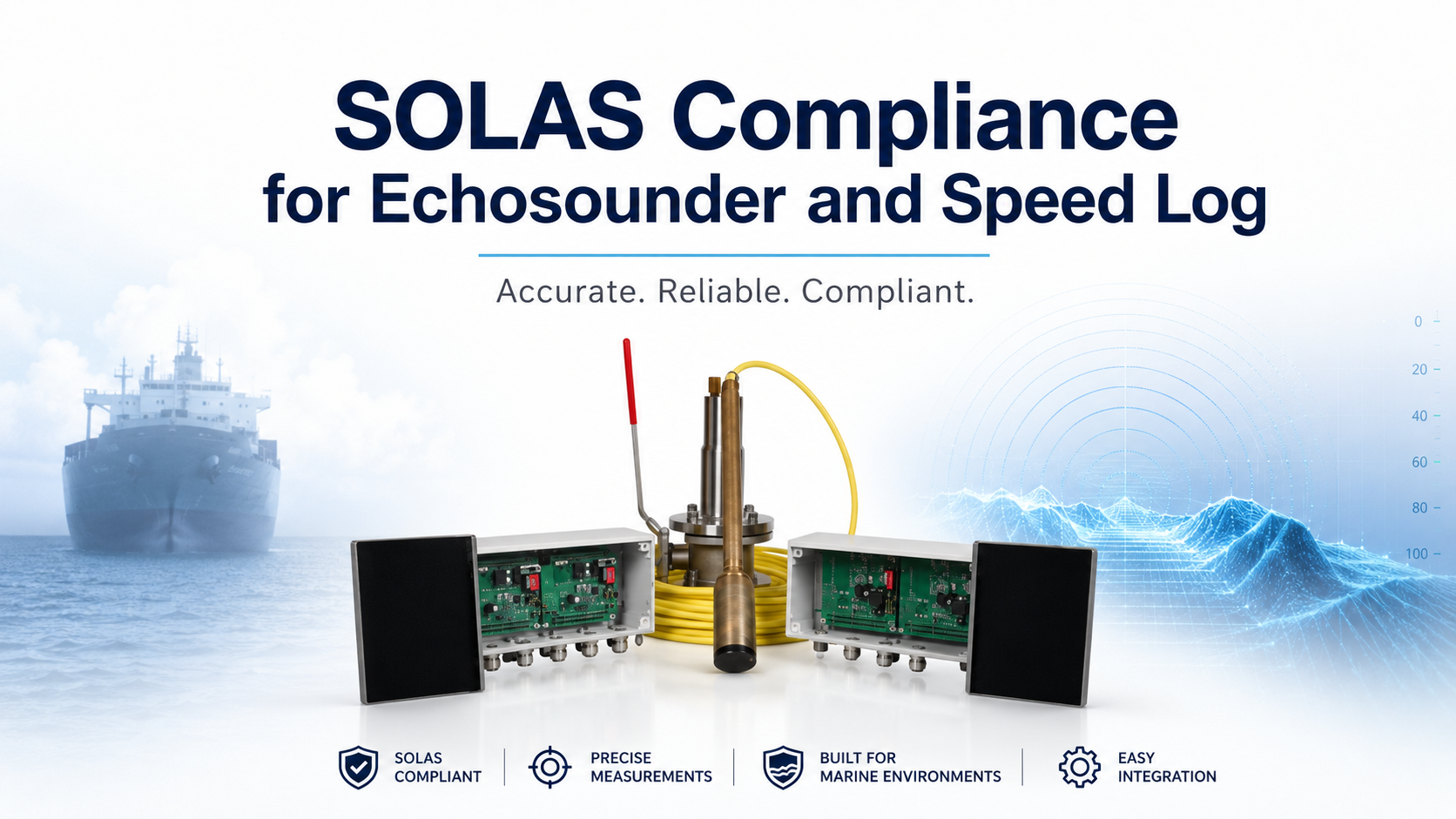
The EDEL-EMES60, produced by Elektro Deniz, is a combined echosounder and speed log system that achieves full SOLAS compliance through a single hull penetration. This is not a compromise. It is a deliberate engineering solution that satisfies both SOLAS V/19.2.3.2 (echosounder) and SOLAS V/19.2.3.4 (speed log) with one integrated sensor.
4.1 Certification and Type Approval
The EDEL-EMES60 holds the following certifications:
| Certification | Scope |
|---|---|
| IMO Wheelmark | Full type approval under EU Marine Equipment Directive |
| MED-B | Module B — EC type examination certificate |
| MED-C | Module C — Quality system conformity |
| SOLAS V/19 Compliant | Satisfies carriage requirements for echosounder and speed log |
This certification structure means the EDEL-EMES60 is accepted by flag state administrations and port state control inspectors across all major maritime jurisdictions.
4.2 Technical Compliance Points
The EDEL-EMES60 addresses each compliance dimension as follows:
Echosounder function: Advanced analog and digital signal processing provides accurate depth measurement in sea, river, and brackish water environments. Temperature-based automatic sound speed calibration ensures precision without manual adjustments-a direct requirement under IEC 61023 and MSC.74(69) Annex 4.
Speed log function: Optimized electromagnetic log parameters deliver accurate speed-through-water in all water types. The system meets the accuracy and operating range requirements of IMO A.824(19) and the updated MSC.334(90) standard applicable to post-2014 installations.
Interface compliance: Full IEC 61162-1, IEC 61162-2, and IEC 61162-450 (Lightweight Ethernet) interface support ensures the EDEL-EMES60 integrates correctly with ECDIS, VDR, autopilot, and other bridge navigation systems, all of which rely on accurate, standardized depth and speed data feeds.
General equipment standards: The system conforms to IEC 60945 environmental performance requirements (vibration, humidity, temperature, electromagnetic compatibility), as required by SOLAS Regulation 18 and IMO A.694(17).
5. Port State Control Inspection: What Surveyors Check
Understanding what a PSC inspector actually looks for helps operators prepare correctly. For echosounder and speed log equipment, inspectors typically verify:
- Physical presence and operability; the equipment must be installed, switched on, and producing valid data output
- Type approval certificate; a valid Wheelmark certificate or flag state type approval document must be on board
- Calibration records; recent calibration verification, particularly for the speed log
- Integration with bridge systems; depth and speed data must be feeding correctly into ECDIS and VDR
- Logbook entries ;evidence of regular operational checks
A combined system like the EDEL-EMES60 simplifies this inspection considerably: one certificate covers both functions, one calibration record applies to both outputs, and one service record covers both systems.
6. New Build vs. Retrofit: Different Paths to Compliance
New Build Vessels
For vessels under construction, integrating the EDEL-EMES60 at the design stage offers the cleanest outcome. A single, small-diameter hull penetration is planned from the outset, minimizing structural complexity. Installation is carried out before launch, with commissioning and calibration completed at the shipyard.
Elektro Deniz has extensive new build experience across commercial vessels, tugs, and naval platforms with over 600 new build projects completed since 1975. EDEL-EMES60 integration is supported from initial specification through to sea trial.
Retrofit on Existing Vessels
Retrofit compliance upgrades are common when existing equipment reaches end-of-life or fails type approval under updated standards. The EDEL-EMES60 is particularly advantageous in retrofit scenarios:
- If the existing vessel already has one hull penetration for either echosounder or speed log, the EDEL-EMES60 can use that single existing penetration for both functions
- LAN connectivity and standard NMEA interface support simplify integration with existing bridge equipment
- Remote data presentation options allow the display unit to be positioned separately from the sensor, reducing bridge clutter
7. Compliance Checklist: EDEL-EMES60 Against SOLAS Requirements
SOLAS Requirement Regulation EDEL-EMES60 Status Echo sounding device (≥300 GT cargo ships) V/19.2.3.2 ✅ Compliant Speed and distance measuring device (≥300 GT) V/19.2.3.4 ✅ Compliant IMO type approval (performance standards) V/18 ✅ IMO Wheelmark IEC 60945 environmental standards V/18 ✅ Compliant IEC 61162-1/2 interface standards V/18 ✅ Compliant IEC 61162-450 (LAN interface) V/18 ✅ Compliant EU Marine Equipment Directive (Wheelmark) MED ✅ MED-B + MED-C 8. Frequently Asked Questions
Can a single combined system satisfy both the echosounder and speed log carriage requirements?
Yes. SOLAS V/19 specifies functional requirements. It requires that depth measuring capability and speed measuring capability are both present on the vessel. A single integrated system that delivers both functions through one type-approved device satisfies both requirements simultaneously. The EDEL-EMES60 is specifically type-approved in this configuration.Is the Wheelmark accepted by all flag states?
The IMO Wheelmark under the EU Marine Equipment Directive is recognized as equivalent to IMO type approval by most major flag states including Panama, Marshall Islands, Liberia, Bahamas, and Cyprus. For flag states with specific national approval requirements, Elektro Deniz can support the submission of documentation.What happens if the speed log requires calibration during a voyage?
The EDEL-EMES60 features automatic sound speed calibration based on water temperature sensing, reducing the frequency of manual calibration interventions. For planned calibration, the system supports remote operation via LAN connectivity, enabling calibration checks without requiring hull access at sea.Does the single-penetration design affect measurement accuracy?
No. The EDEL-EMES60 uses signal processing channels for depth and speed measurement within the same sensor assembly. The electromagnetic speed log and echosounder functions operate on different physical principles and do not interfere with each other. Measurement accuracy meets or exceeds the requirements of both IEC 61023 and IEC 62616.